
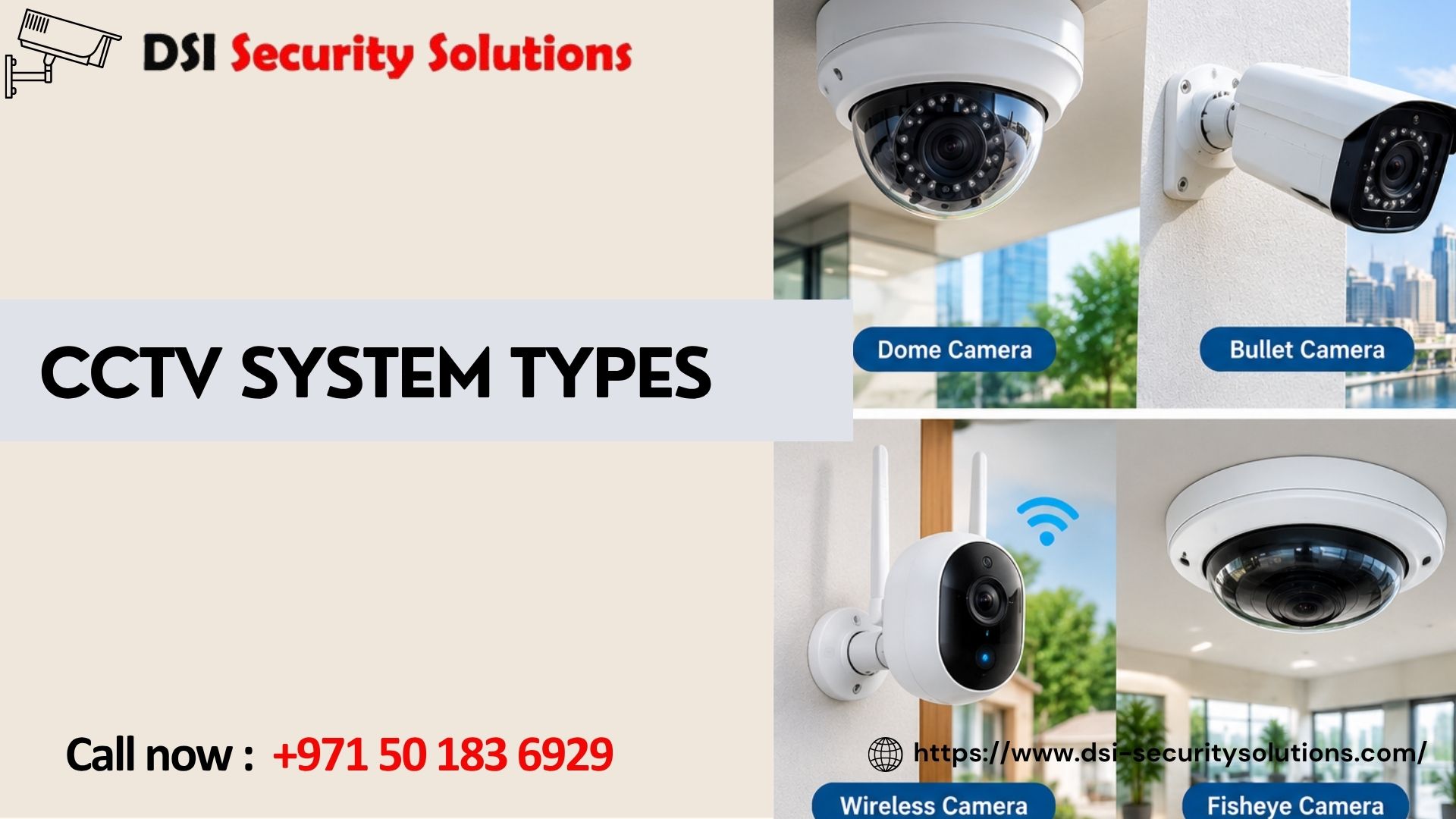
CCTV System Types: A Complete Guide to Choosing the Right Surveillance Setup
Before installing any surveillance equipment, it helps to understand the different CCTV system types available and what actually separates them, beyond marketing terms and technical jargon. The right choice depends on your property, budget, and what you actually need the system to do, whether that’s simply deterring opportunistic theft or capturing detailed evidence for a legal matter.
At DSI Security Solutions, we help homeowners and businesses across Dubai choose between these system types every day. This guide breaks down each option in plain terms, so you can make an informed decision, whether you’re planning to buy equipment yourself or arranging professional installation.
Why Understanding CCTV System Types Matters
Camera technology has expanded significantly over the past decade, and the terminology can be confusing. Two systems that look similar in a product listing can perform very differently in practice. Understanding the core system types helps you:
- Avoid paying for features you don’t actually need
- Choose a system that suits your property’s layout and cabling situation
- Set realistic expectations for image quality, especially at night
- Plan for future expansion without needing to replace everything later
- Have a more informed conversation with any installer or supplier
Analog CCTV Systems
Analog systems remain one of the most established CCTV system types, using coaxial cabling to connect cameras directly to a digital video recorder (DVR).
How it works: Each camera sends a continuous analog video signal to the DVR, which converts and stores the footage.
Strengths: Generally the most affordable option upfront, simple to understand, and well-suited to smaller properties with straightforward coverage needs.
Limitations: Lower resolution compared to newer alternatives, less flexibility for advanced features like smart analytics, and cabling distance limitations for larger properties.
Best suited for: Small shops, budget-conscious home setups, and situations where basic deterrence and recording matter more than high-resolution detail.
IP (Network) Camera Systems
IP cameras represent a significant step up in capability and have become the standard choice for many new installations.
How it works: Cameras convert video to digital data and send it over a network connection, either wired (Ethernet) or wireless, to a network video recorder (NVR) or cloud platform.
Strengths: Higher resolution options, better zoom and detail retention, easier integration with mobile apps, and often built-in smart features like motion zones or basic analytics.
Limitations: Generally higher upfront cost than analog equivalents, and performance depends on adequate network infrastructure and bandwidth.
Best suited for: Homes and businesses wanting sharper image quality, remote access via a reliable app, and the flexibility to add smart features later.
Wireless CCTV Systems
Wireless cameras have grown in popularity due to their flexibility and simple installation process.
How it works: Cameras transmit video over Wi-Fi rather than through data cabling, though most still require a power connection or rechargeable battery.
Strengths: Fast, low-disruption installation, flexible placement almost anywhere with signal coverage, and well-suited to rented properties or retrofit projects.
Limitations: Performance depends on a stable Wi-Fi signal, battery-powered units need periodic recharging, and larger properties may need a mesh network or extenders.
Best suited for: Homeowners, tenants, and locations where running cable would be impractical or overly disruptive.
Wired vs Wireless: A Direct Comparison
It’s worth noting that “wired” and “wireless” describe how a camera connects, while “analog” and “IP” describe how it processes video, so these categories can overlap. A wired system offers stable, uninterrupted performance without relying on Wi-Fi bandwidth, but requires cabling work during installation. A wireless system installs faster and repositions easily, but depends on consistent network signal strength. Many properties use a hybrid approach, combining wired cameras at fixed, high-priority points with wireless units for flexible coverage elsewhere.
PTZ (Pan-Tilt-Zoom) Cameras
PTZ cameras are a specialised type designed for active monitoring of large areas.
How it works: These cameras can be remotely controlled to pan, tilt and zoom, either manually or through automated patrol patterns, covering a much wider area than a fixed camera.
Strengths: Excellent for large open spaces like warehouses, car parks and perimeters, since one PTZ camera can replace several fixed units.
Limitations: Higher cost per unit, and effective use often requires active monitoring or programmed patrol routes rather than passive recording.
Best suited for: Warehouses, large commercial sites, and perimeter security where flexible, wide-area coverage matters more than fixed close-up detail.
Dome Cameras
Dome cameras are a common fixed-camera format, particularly for indoor use.
How it works: Housed in a dome-shaped casing, these cameras are typically mounted on ceilings and offer a discreet, tamper-resistant design.
Strengths: Less obvious camera direction, which can deter tampering, along with a compact, unobtrusive appearance suited to retail stores, offices and lobbies.
Limitations: Field of view is generally fixed once mounted, and some models offer less zoom range than bullet-style alternatives.
Best suited for: Indoor commercial spaces, retail environments and offices wanting discreet, ceiling-mounted coverage.
Bullet Cameras
Bullet cameras are a highly visible, cylindrical camera type frequently used outdoors.
How it works: Named for their elongated shape, bullet cameras are typically wall or pole-mounted, with a fixed direction pointed at a specific area.
Strengths: Highly visible design that reinforces deterrence, generally good range and clarity for outdoor use, and straightforward installation.
Limitations: Fixed field of view, and visible mounting can sometimes make them a more obvious target for tampering than discreet dome alternatives.
Best suited for: Entrances, driveways, perimeters and any area where visible deterrence is a priority.
Multi-Sensor and Panoramic Cameras
An increasingly common category, these cameras use multiple lenses or sensors within a single unit to capture a wider field of view than a standard fixed camera.
How it works: Several image sensors are combined, either stitched into one panoramic view or managed as separate feeds, allowing one unit to cover an area that might otherwise need multiple fixed cameras.
Strengths: Reduced camera count for wide areas, often more cost-effective than installing several separate units to achieve similar coverage.
Limitations: Generally higher unit cost than a single standard camera, and coverage quality can vary depending on the specific product.
Best suited for: Large open areas, warehouse floors, and parking areas where wide coverage from a single mounting point is valuable.
Thermal and Infrared-Enhanced Cameras
For specific high-risk or challenging environments, thermal cameras represent a more specialised system type.
How it works: Thermal cameras detect heat signatures rather than relying on visible light, allowing them to identify movement even in complete darkness, smoke or fog.
Strengths: Reliable detection in conditions where standard cameras struggle, useful for perimeter security in low-visibility situations.
Limitations: Significantly higher cost than standard cameras, and image detail is generally lower for identification purposes compared to visible-light cameras.
Best suited for: High-security perimeters, industrial sites and situations requiring detection in total darkness or poor visibility.
Choosing the Right CCTV System Type for Your Property
For homes: Most homeowners benefit from a mix of IP or wireless cameras, using bullet-style units at entrances and driveways, with dome cameras for indoor common areas if needed.
For retail stores: IP cameras with dome styling for indoor discretion, combined with bullet cameras at entrances for visible deterrence.
For offices: IP dome cameras covering reception areas, entry points and shared spaces.
For warehouses and large sites: A combination of PTZ cameras for wide-area coverage, bullet cameras for perimeter points, and multi-sensor units for open floor areas.
For high-security or low-visibility environments: Thermal cameras alongside standard IP cameras for a layered approach to detection.
There’s rarely a single “correct” system type. Most well-designed installations combine two or three types, matched to what each specific area of the property actually needs.
How System Type Affects Storage and Network Requirements
Higher-resolution IP cameras, PTZ units and multi-sensor cameras all generate more data than basic analog systems, which affects your storage capacity needs and, for larger installations, your network infrastructure. It’s worth factoring this into your decision early, particularly for commercial or industrial sites planning a larger number of cameras.
Getting Expert Advice Before You Choose
Because CCTV system types can be combined and configured in many different ways, the most reliable approach is a proper site assessment, where an installer can recommend the right mix based on your property’s layout, lighting conditions and specific security priorities, rather than choosing based on a generic online description alone.
Frequently Asked Questions
What is the most common CCTV system type today?
IP (network) camera systems have become the most common choice for new installations, largely due to higher resolution, easier remote access and smart feature integration, though analog systems remain a reasonable, cost-effective option for simpler setups.
Which CCTV system type is best for outdoor use?
Bullet cameras are commonly used outdoors due to their visible deterrent design and good range, though dome cameras with appropriate outdoor-rated housings are also a suitable choice for a more discreet appearance.
Do I need a PTZ camera for my home?
Most homes don’t require a PTZ camera, since fixed bullet or dome cameras usually provide sufficient coverage for entrances and outdoor areas. PTZ cameras are typically more valuable for large commercial or industrial sites needing wide-area coverage.
What’s the difference between analog and IP CCTV systems?
Analog systems use coaxial cabling and connect to a DVR, generally offering lower resolution at a lower cost. IP systems send digital video over a network to an NVR or cloud platform, typically offering higher resolution and more advanced features.
Can different CCTV system types be combined in one installation?
Yes, and this is very common. Many properties use a mix of camera types, such as bullet cameras at entrances, dome cameras indoors, and PTZ units for large open areas, matched to each location’s specific needs.
Are thermal cameras necessary for a home security system?
Generally not. Thermal cameras are a specialised, higher-cost option typically reserved for high-security perimeters or industrial sites requiring detection in total darkness, rather than standard residential use.
Which CCTV system type is easiest to install?
Wireless cameras are generally the easiest and fastest to install, since they don’t require running data cabling, though they still need a power source and a stable Wi-Fi connection to perform reliably.
How do I know which CCTV system type is right for my property?
The best approach is a site assessment, where the layout, lighting conditions and specific security priorities of your property can be properly evaluated before recommending a system type or combination of types.
Get Expert Advice on Choosing the Right CCTV System
With so many CCTV system types available, choosing the right combination for your property is easier with expert input. Contact DSI Security Solutions today for a free consultation and a recommendation tailored to your home or business